Treatment Details
Hello,
This is Jihyun Park,
Chief Director and Prosthodontist at Seoul Yido Dental Clinic.
"I brush meticulously three times a day,
so why do my gums keep swelling?"
This is one of the most frequent questions we hear in the clinic.
In such cases, the cause is often not poor brushing habits,
but rather the existing
prostheses in the mouth.
If the structure prevents a toothbrush or floss from reaching certain areas,
no matter how diligently you brush,
those spots will remain unclean.
The first condition for a prosthesis is that it must be cleanable.
When people think of prostheses,
most immediately imagine
a beautiful color and shape.
Of course, that's important.
However, I prioritize
whether it has a 'cleanable design.'
Simply put, can the patient
surrounding teeth.
reach it with a toothbrush and floss
at home?
That's the question.
If the design prevents cleaning tools from entering,
plaque will accumulate continuously,
leading to gum swelling,
and in the worst case, even bone loss.
While this is very basic knowledge now,
in the 80s and 90s, when this concept wasn't widely known,
many prostheses were made
without considering this aspect.
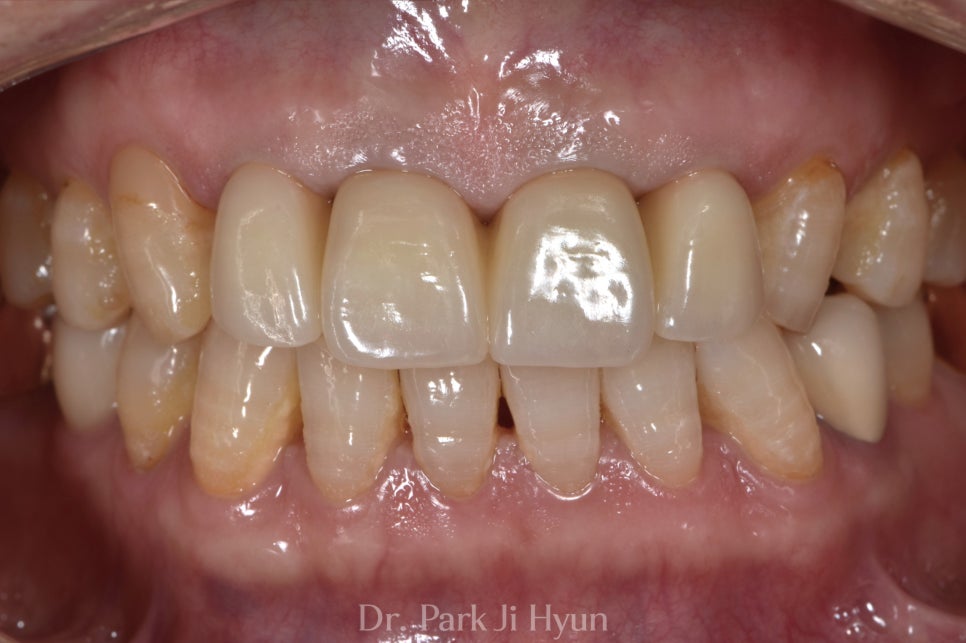
The gum color was discolored.
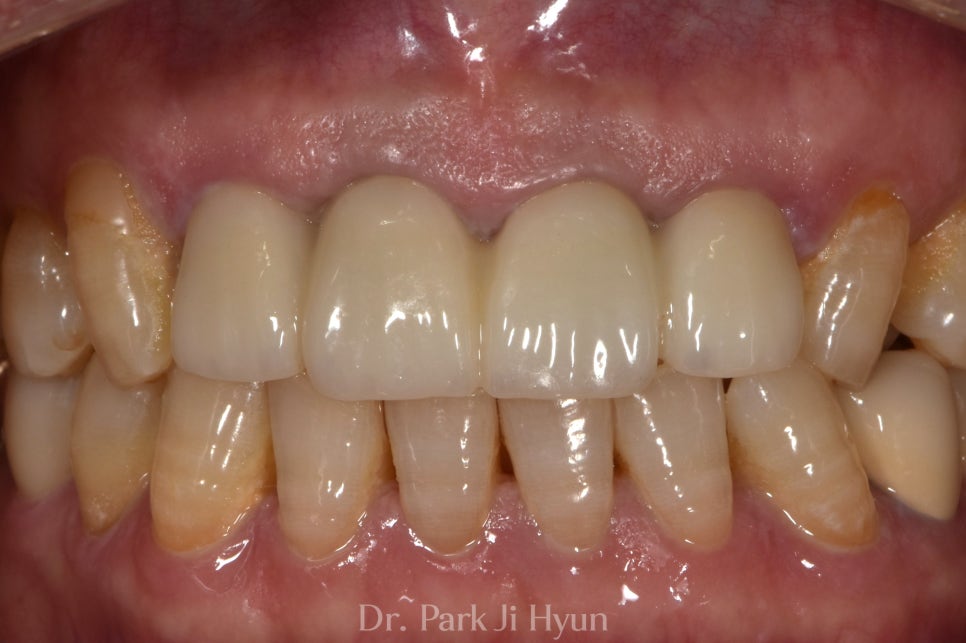
This patient visited us complaining of persistent discomfort
in their anterior gums.
Looking at the photos, we can see
the gums were not a healthy pink
but rather a bluish color,
with some areas appearing inflamed.
The cause was a 'wall' created by the prostheses.
The existing prostheses had a structure where the teeth were
interconnected in an unusual way.
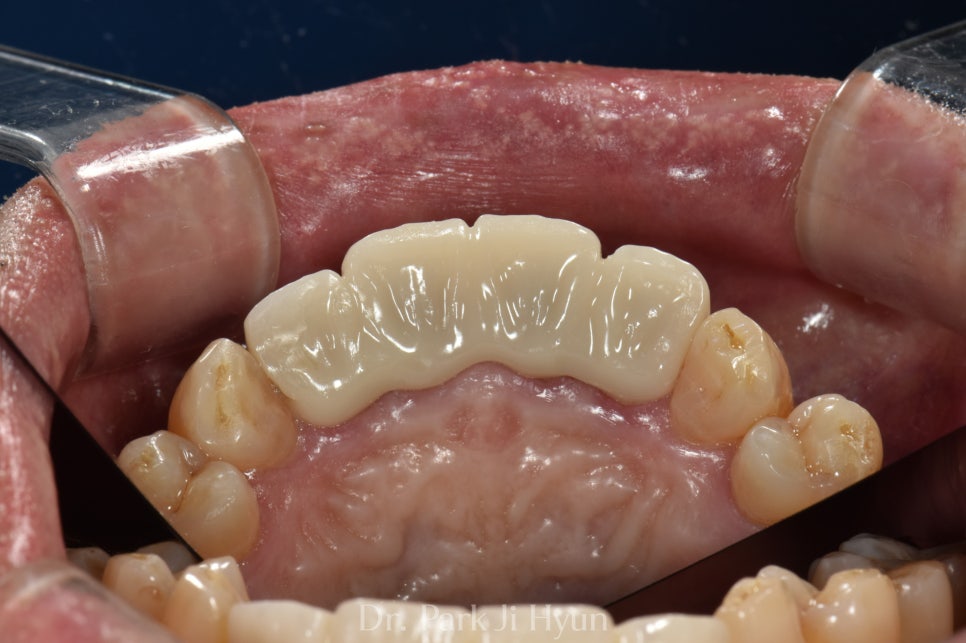
The problem was that this shape created a wall
at the back of the interdental spaces.
Even if a toothbrush or floss was inserted from the front,
it would be blocked by this wall, unable to reach
the area where plaque had accumulated.
From the gums' perspective, they were essentially
living with bacteria every day.
We first created space for the gums to recover with temporary prostheses.
The patient had a very strong desire
to regain healthy gums.

Therefore, we removed all existing prostheses
and fabricated and placed temporary prostheses.
The most crucial aspect we focused on was
creating sufficient space
between the teeth.
Gums that have been compressed by prosthetics will
naturally grow back once the pressure is removed.
However, there must be space for them to grow into.
This process does not happen quickly.
Nor should it.
It's a period where we must wait
for the gums to recover at their own pace.
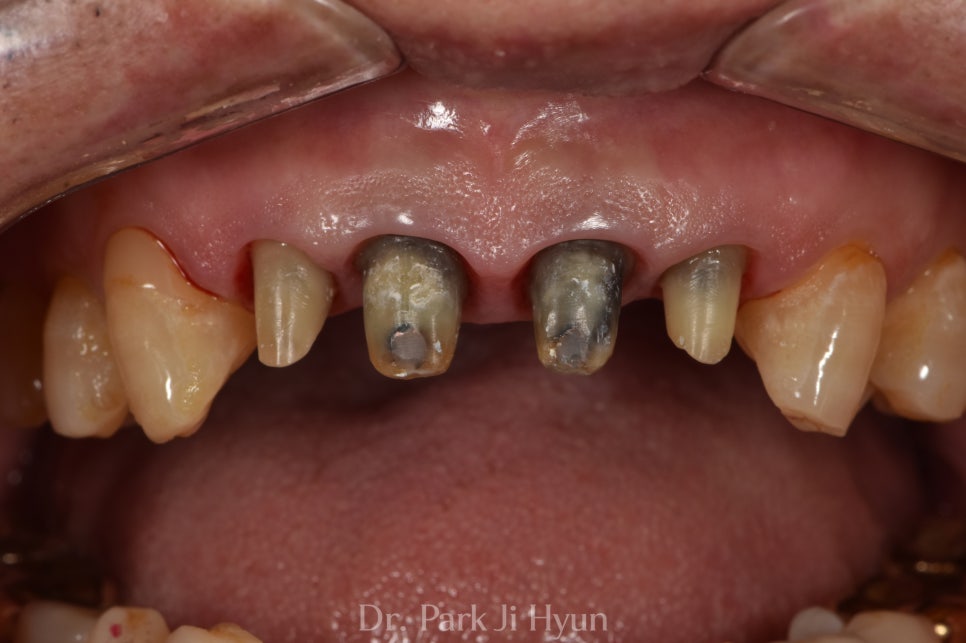
This is the gum condition observed before taking impressions.
The bluish tint has disappeared,
and you can see a very clean recovery.
Therefore, the final prosthesis should only be fabricated
after confirming healthy gums.
If impressions are taken over swollen gums, later on,
as the gums recede, the fit between the prosthesis
and the gums will become misaligned again.
Color: Not 'white,' but 'harmonious'
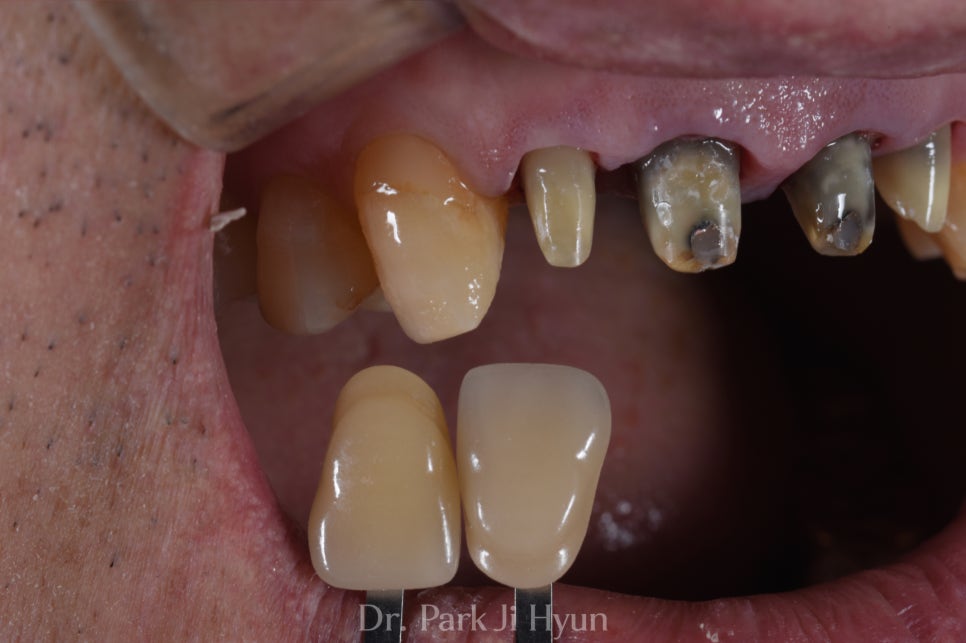
When determining the final color,
we planned a shade that wouldn't be excessively whiter than the surrounding teeth,
yet would still appear youthful and bright.
We planned a shade that would still appear youthful and bright.
If the front teeth are made too white,
they will stand out more unnaturally.
The most natural and ultimately better-looking result is achieved when they blend with the surrounding teeth.
The most natural and ultimately better-looking result is achieved when they blend with the surrounding teeth.
Final Prosthesis Customized to Healthy Gum Contours
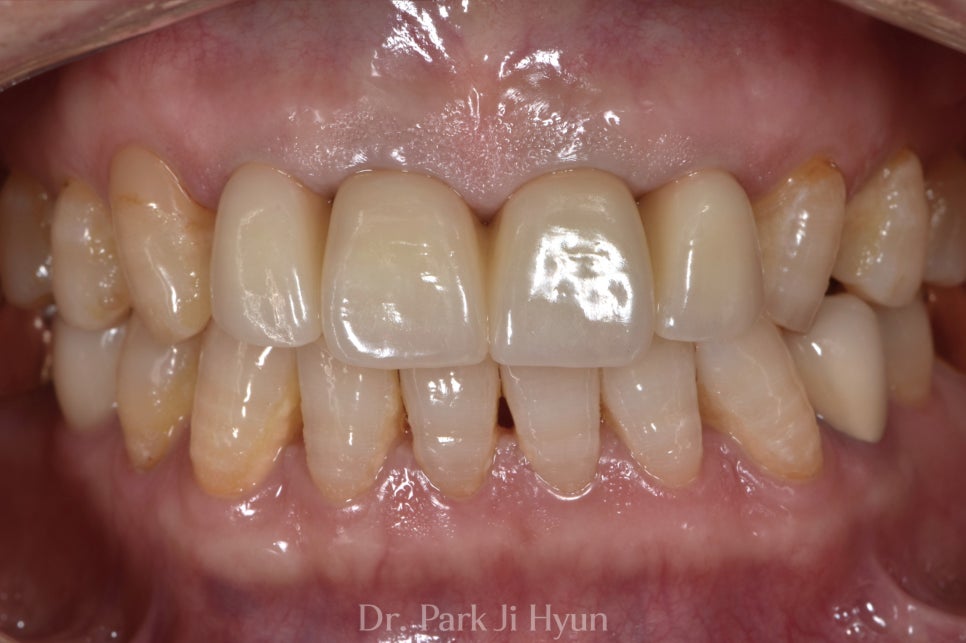
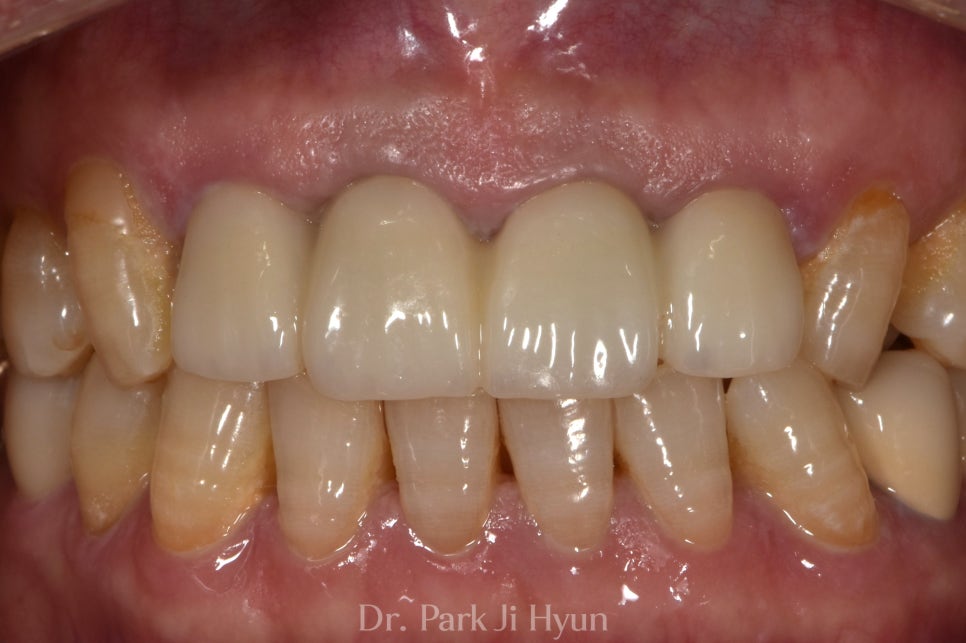
The completed final prosthesis has been placed.
While following the recovered gum contours precisely,
the shape was delicately refined so that the spaces between the teeth
are not visible externally.
At this point, you might ask a question:
"If you create space between the teeth,
won't it look like a black gap?"
This is a perfectly valid concern.
Indeed, the phenomenon of black spaces between teeth
is known as a 'black triangle,'
named because it appears as a dark triangular shape.
named because it appears as a dark triangular shape.
Therefore, when designing the shape of the prosthesis,
we leave the area below the gumline open so that cleaning tools
can pass through,
while the visible upper part
is designed to meet naturally.
✔ Inside: Allows for cleaning
✔ Outside: No visible gaps
Satisfying both of these conditions simultaneously
is the most challenging yet essential task.
is the most challenging yet essential task.
Ultimately, a good prosthesis
should not only look good at the moment
it is completed at the dental clinic.
It must be designed from the outset to allow the patient to manage it sufficiently at home,
and to ensure the surrounding teeth and gums remain healthy.
and to ensure the surrounding teeth and gums remain healthy.
Seoul Yido Dental Clinic
From the perspective of a prosthodontist,
not only the color and shape of the teeth,
but also the occlusion, the condition of the surrounding gums,
and the patient's condition after treatment
and even how it will be managed in the future.
We aim to consider all these aspects together.
'Walking the right path, striving for perfection.'
Even when creating a single prosthetic,
rather than focusing solely on its immediate appearance,
we prioritize its long-term comfort, usability,
and ease of maintenance.
This is the direction of prosthetic treatment
that we value most.
We hope today's content was helpful.
Dr. Lee Do-Hyun, Director of Seoul Yido Dental Clinic, Mapo
This was Prosthodontist Dr. Jihyun Park.
Thank you.