Treatment Details
Hello, this is the Chief Director of Seoul Yido Dental Clinic.
Chief Director and Prosthodontist at Seoul Yido Dental Clinic.
Which area for implant surgery is considered the most challenging?
It's the front teeth.
The reason the anterior region is known to be more challenging than other areas
can be found in the characteristics of the gums and bone surrounding the front teeth.
The gums and bone in the front tooth area are thin, making them more susceptible to
collapse if the initial procedure fails.
Therefore, from determining the incision line to bone grafting, gum grafting, implant placement,
and the subsequent prosthetic fabrication, every step requires a meticulous approach.
It literally requires 'craftsmanship.'
Due to these characteristics, anterior implant procedures must be performed with caution,
but if these steps are not properly executed by the surgeon,
it often leads to failure.
Failure ultimately leads to considering implant reoperation,
and the problem is that implant reoperations are often more complex than the initial surgery.
Why is reoperation more difficult?
Scar tissue forms in areas that have undergone surgery at least once,
which can cause the gum and bone healing response to differ from expectations.
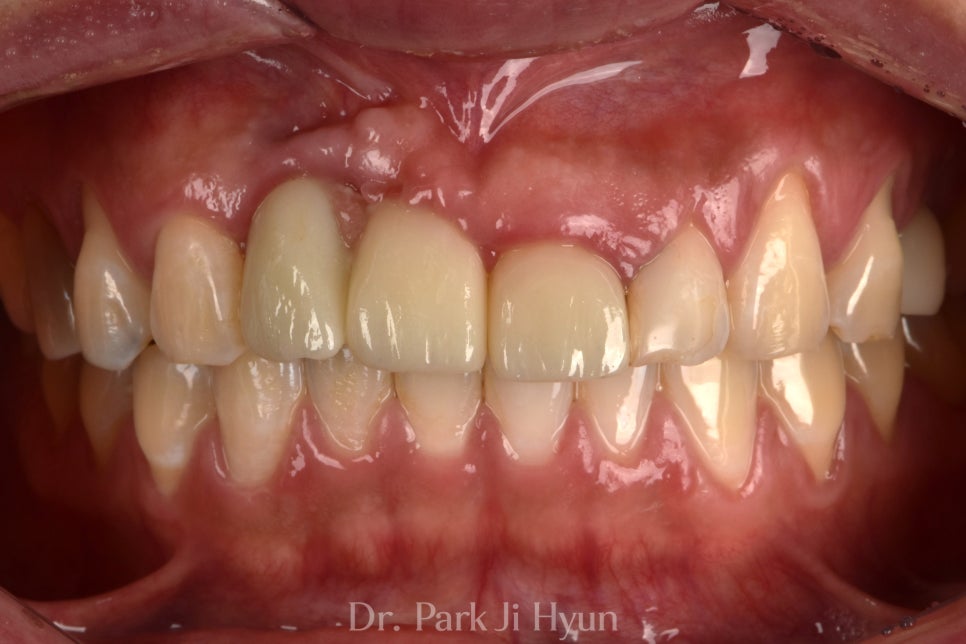
If implant surgery involving bone and gum grafting fails and reoperations are repeated,
the gum condition inevitably worsens.

The gums progressively collapse uncontrollably, leaving only scars,
and some individuals give up and live with aesthetically unpleasing gums and prosthetics.
Some individuals give up and live with aesthetically unpleasing gums and prosthetics.
Since damage to the gums and bone often accumulates during repeated treatment processes,
it is crucial to thoroughly assess the condition of the existing tissue
before planning an implant reoperation.
Tissue Grafting: A Solution for Gum Problems
In such situations, it is paramount to meticulously examine the gum condition,
and if inflammation is present, the priority is to restore the gums to a healthy state.

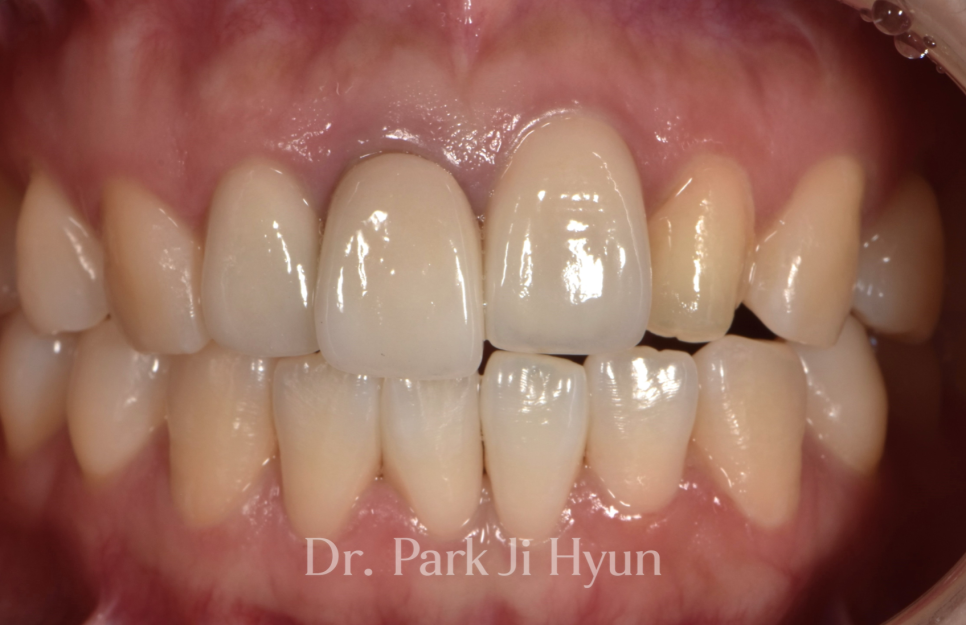
This shows the gums after removing the existing prosthesis to reduce inflammation and allowing them to
recover to some extent.
Upon examining the previously placed implant site, its position is not ideal, but
it can be covered by a prosthesis. To reduce the risks associated with implant re-implantation,
we proceed with the treatment using the existing implant.
we proceed with the treatment using the existing implant.
Gum Tissue Grafting
When there is insufficient bone volume or a large scar area, making it difficult to restore the gingival contour with bone grafting alone.
When there is insufficient bone volume or a large scar area, making it difficult to restore the gingival contour with bone grafting alone.
In such cases, we consider gum grafting, where the necessary gum tissue is harvested from the palate
and transplanted to the deficient area.
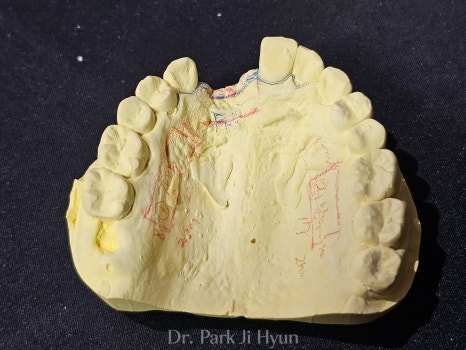

Since bone grafting is not feasible, a significant amount of gum tissue will likely be required.
For accurate planning, impressions must be taken, and the amount and shape of tissue needed for the surgical site
must be meticulously measured.
The procedure is performed after designing the amount and size of gum tissue to be harvested from the palate for tissue grafting.
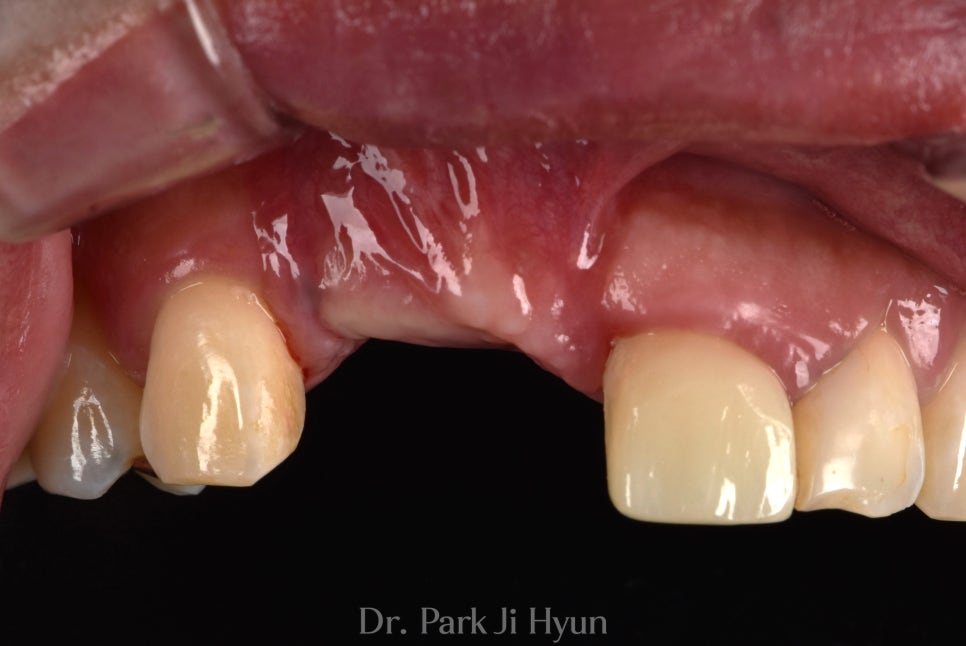
After the grafting and a recovery period, the thinned gums gradually regain their thickness and
volume.
While not ideal, the gums show significant reconstruction compared to their initial state.
While not ideal, the gums show significant reconstruction compared to their initial state.
Although slightly regrettable, we believe that aesthetic improvement can be achieved with a prosthesis
without additional surgery in this state.
Prosthetic Process That Solved the Problem with Minimal Surgery
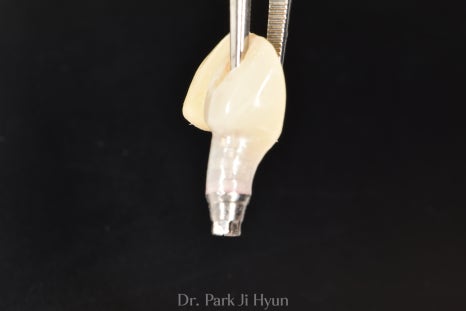
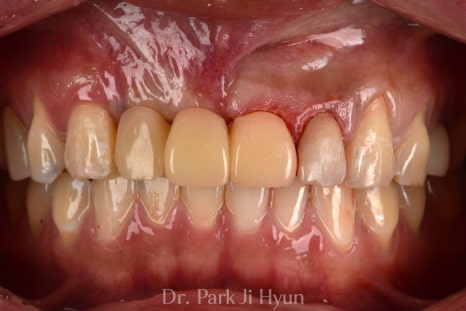
We meticulously adjust the shape of the gums by fabricating a custom temporary prosthesis
through a refining process.
As explained before, this process is essential to create a natural gum line.
can be created.
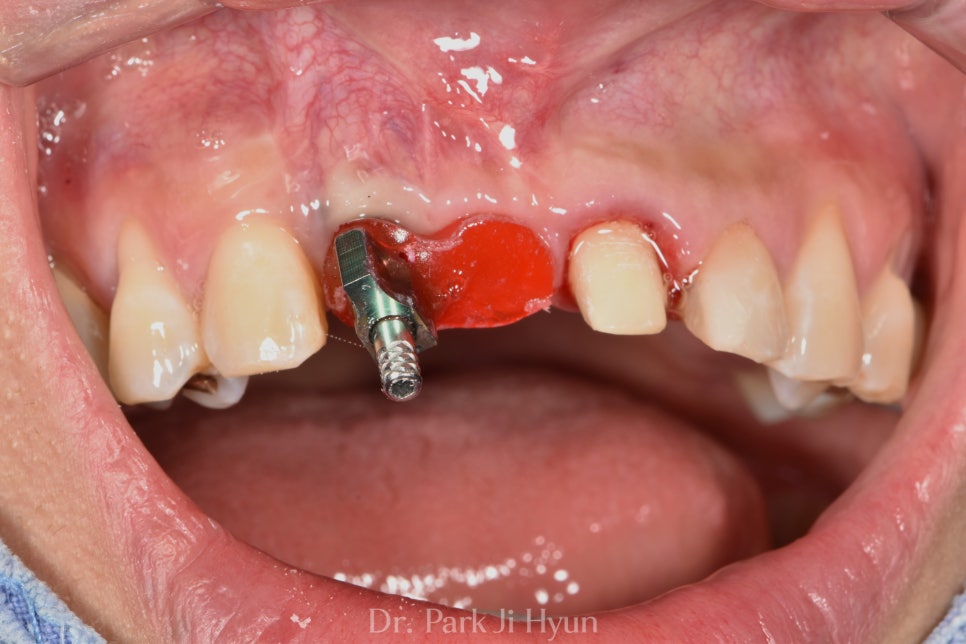
Once the shape of the temporary prosthesis is established,
the final prosthesis is fabricated by replicating that exact form.
While these processes can be time-consuming and cumbersome,
I believe they are essential steps for front tooth implants to achieve good results.
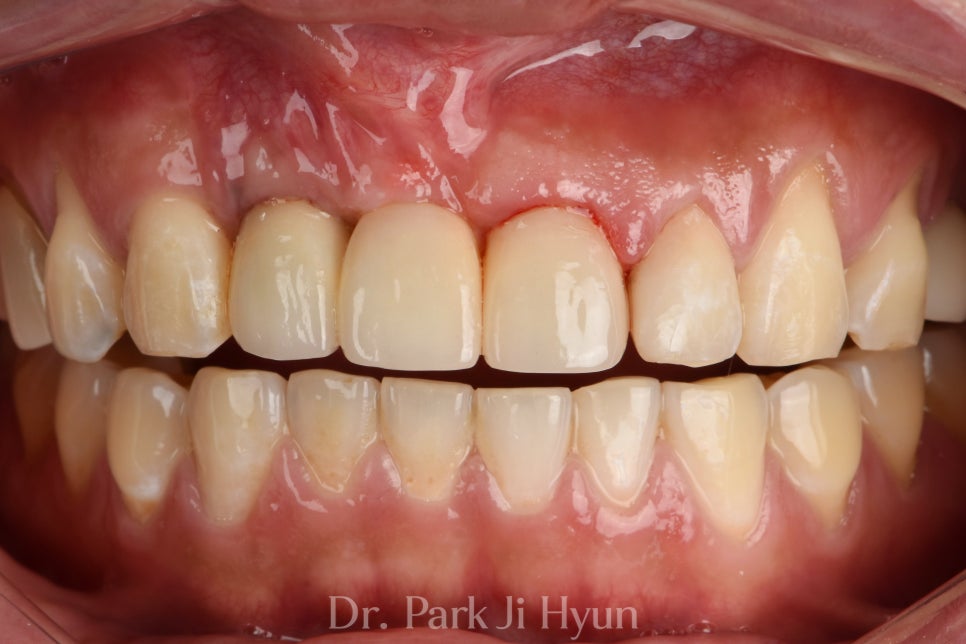
Immediately after placing the final prosthesis, it may appear somewhat unnatural.
In the future, as the gum tissue between the teeth fills in,
and the overall shape naturally settles, it will look much better.
As I've shown you today, the retreatment process following a failure
is a challenging treatment that requires detailed planning and management across multiple stages.
It is crucial to accurately assess the condition of the bone and gums from the initial surgical stage
and approach it with caution.
I believe that a dentist's role is to solve patients' oral concerns and make them smile.
That is the role of a dentist.
To do so, continuous effort and training are constantly needed.
Seoul Yido Dental Clinic will also strive to protect the smiles of all patients who visit us,
and help them regain their beautiful smiles.
Always, as we have always done,
we will be a dental clinic that continuously strives for excellence.
Thank you!
This is Jihyun Park,
This was Prosthodontist Dr. Jihyun Park.