Treatment Details
Hello, I am the Chief Director of Seoul Yido Dental Clinic.
Chief Director and Prosthodontist at Seoul Yido Dental Clinic.
Thank you for your
great interest in the cases we've shared.
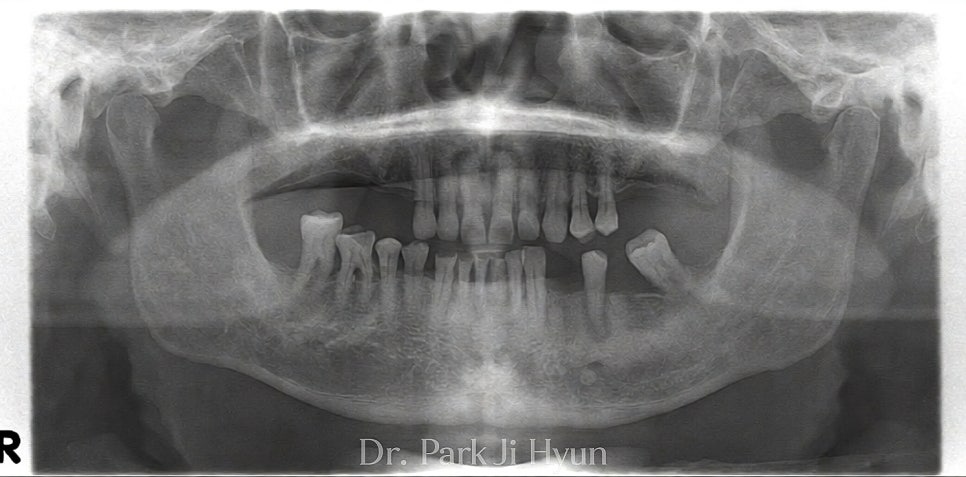
Several molars are already missing, and the remaining teeth are loose or
their shape is not what it used to be.
At this point, it's time to redesign the entire mouth.
This type of treatment is called full-arch restoration.
The outcome of full-arch restoration largely depends on
'the order in which it's done.'
Today, we'll discuss that order
with a real case.
The Most Important Principle of Prosthetic Restoration: Top-down
If I had to pick one most important concept in prosthetic restoration,
I would unhesitatingly say 'Top-down.'
To put it more simply, it's a method where you first draw the finished picture
and then work backward.
After first designing the ideal final outcome,
to achieve that outcome,
✔️ How many implants are needed?
✔️ Where should they be placed?
✔️ Is bone grafting necessary?
✔️ How many prosthetics of what type will be used?
These are decided in reverse order.
It's the same principle as not building a house
by erecting pillars without a blueprint.
If you erect the pillars first,
you won't get the desired result later,
and forcing it to fit will cause problems.
This principle must be followed to create precise and healthy prosthetics
that can be used for 20, 30 years or more.
Implants: Where to Start?
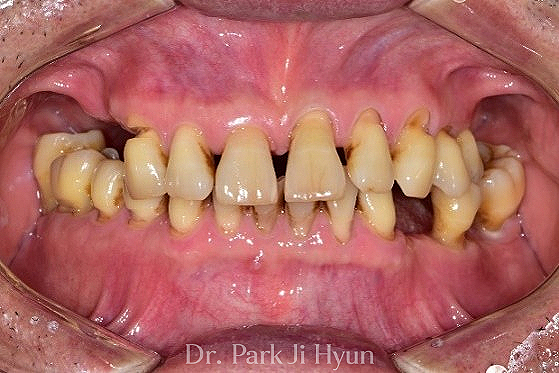
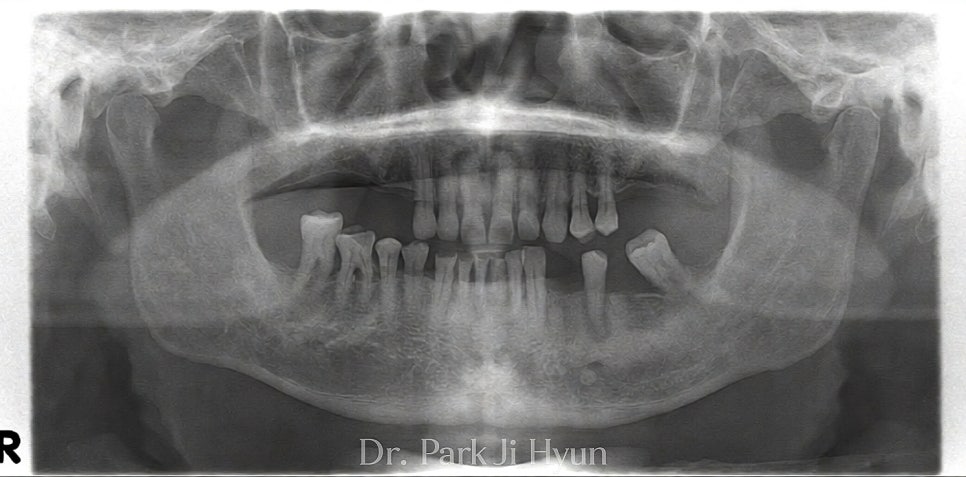
This patient had many missing molars, and the remaining teeth were also
in poor condition due to periodontitis.
Due to gum recession from periodontitis, there were many spaces between teeth,
and their shape was also poor. Therefore, the treatment plan was to restore both function and aesthetics
by placing implants and crowning the salvageable teeth.
we established a treatment plan.
The first thing to establish is the 'position of the temporomandibular joint.'
I don't start by crowning teeth.
As I mentioned in a previous post, to reconstruct a patient's occlusion,
we must first find each individual's ideal temporomandibular joint position.
In this case, we used a 'Lucia jig'
to establish that position.
And at this position, we simulate the ideal final outcome in advance through wax-up.
This wax-up is the 'blueprint' of the Top-down approach
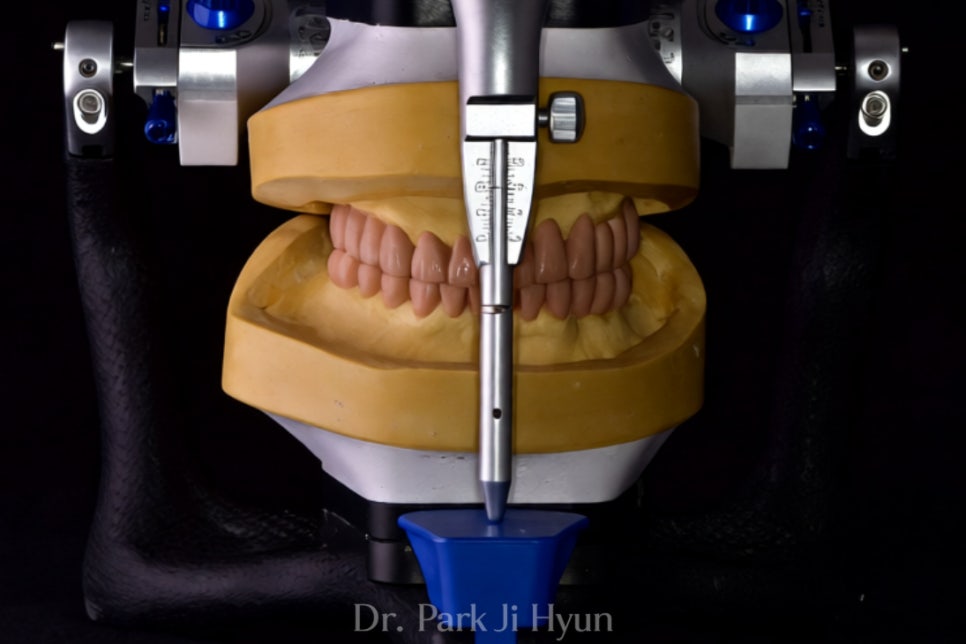
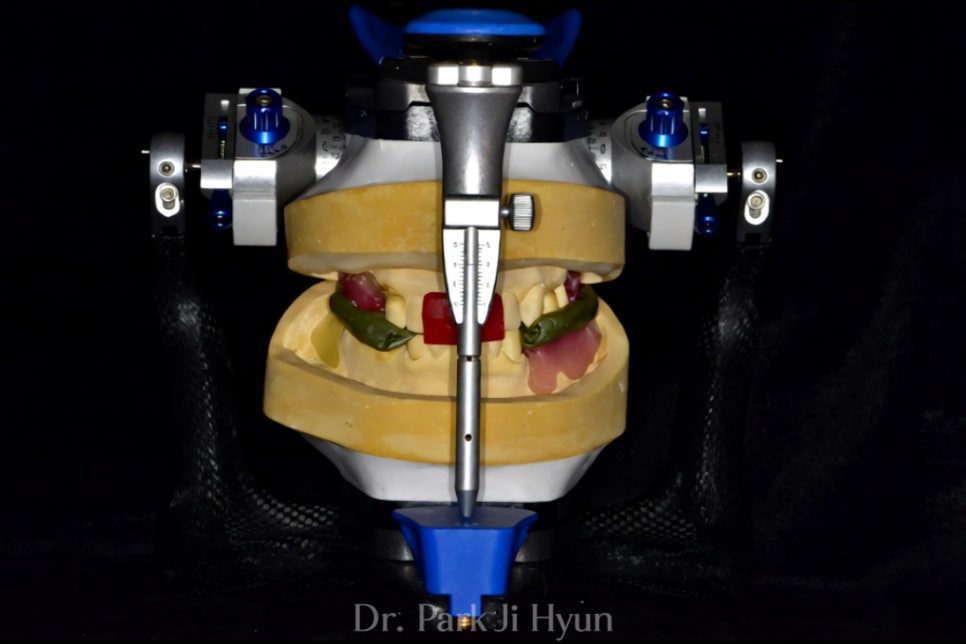
I mentioned earlier.
'blueprint'.
Temporary crowns and dentures, and implants
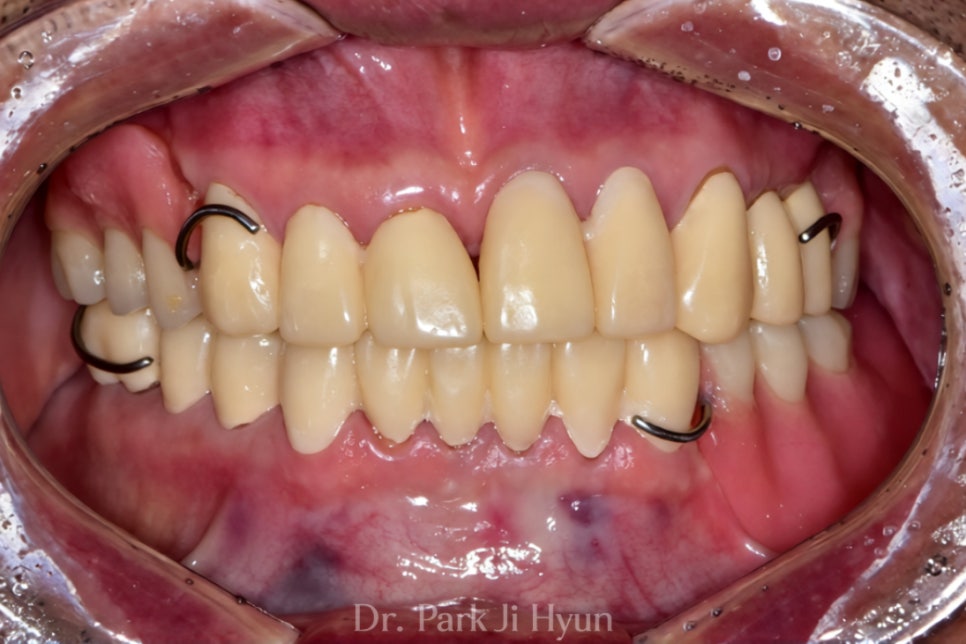
Based on the simulated form, we fabricated temporary crowns and temporary dentures.
We prepared the patient's teeth, placed temporary crowns, and extracted teeth that could not be saved.
Then, we fitted temporary dentures.
The biggest advantage of this stage is that the patient can continue their daily life, eating and conversing, right?
This would be the biggest advantage, wouldn't it?

After the gums healed well, we proceeded with implant placement and bone grafting.
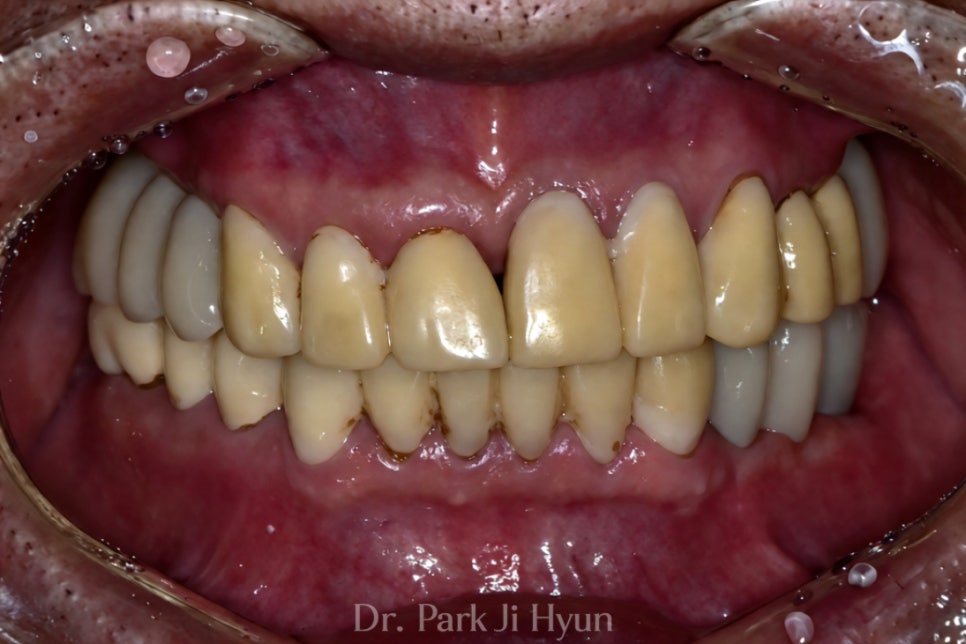
The area where the temporary denture was located at the back will be replaced with implant prosthetics.
Just before the final prosthetics, another temporary prosthetic stage.
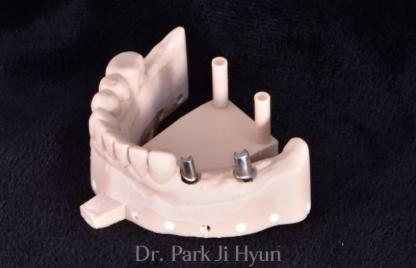
Once the occlusion was stable, we fabricated temporary prosthetics in the same form as the final prosthetics.
We fabricated temporary prosthetics again.
"I already have temporary crowns, why make them again?"
You might be thinking this.
Once the final prosthetics are placed, modifications are not easy.
Therefore, it is necessary to first use temporary prosthetics in the exact same form as the final ones
to verify if the occlusion and form are actually comfortable.
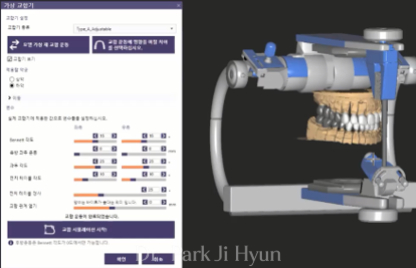
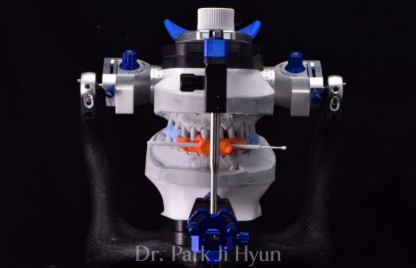
In this case, we utilized the Twin-stage technique for precise occlusion.
This method designs the occlusal surface considering the path of jaw movement.
One of my clinical case papers was also written on this topic.
Now, we place the completed final prosthetics.
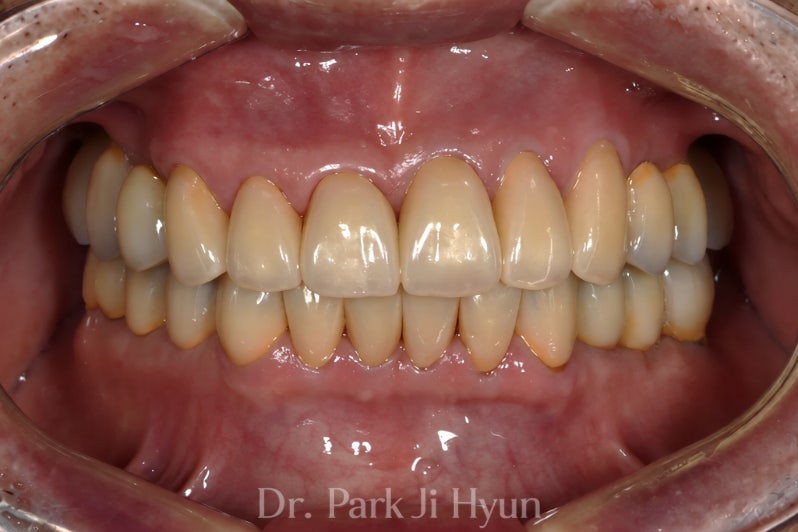
To be honest, the prosthetics don't just appear instantly.
There was a gum contouring process in between, and additional temporary prosthetic procedures.
It is the result of painstaking efforts to create precise prosthetics.
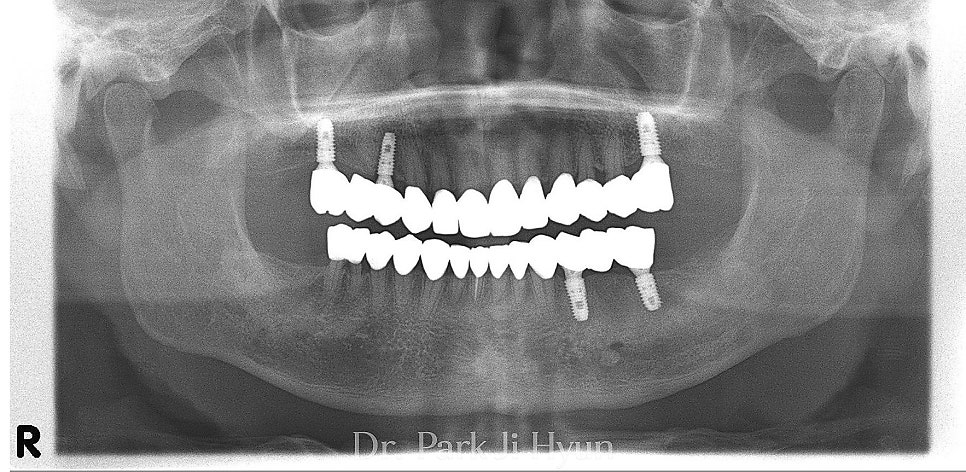
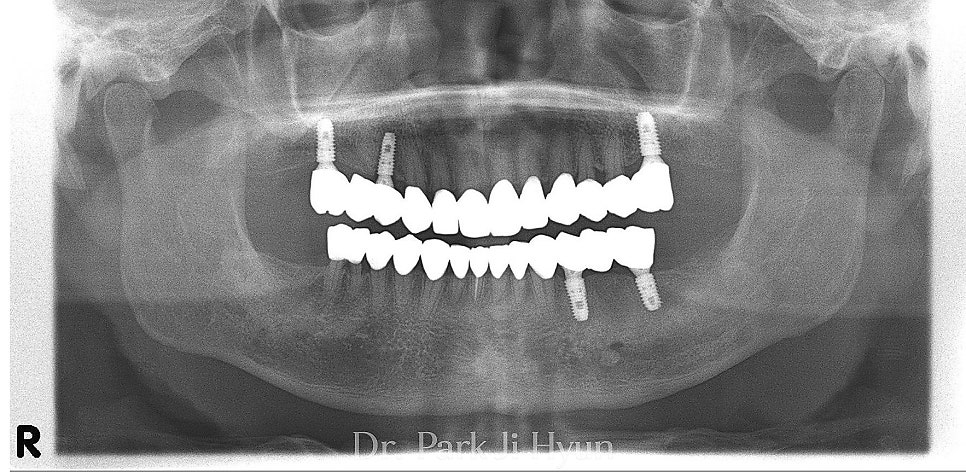
The final X-ray shows healthy, well-positioned teeth and implants,
and you can confirm the uniform alignment of the teeth.
Can full-arch crown restoration be made to look natural and beautiful?
"Won't it be too obvious if I get a lot done?"
"What if it looks unnatural, like dentures?"
In fact, full-arch restoration actually has aesthetically advantageous conditions.
When treating only one or two teeth, there are limitations that require matching the color and shape of the adjacent natural teeth.
There are limitations that require matching the color and shape of the adjacent natural teeth.
If already worn or discolored teeth become the standard,
the results will also have limitations.
However, full-arch restoration allows us to set new standards from the beginning.
Aligning the midline of the teeth with the facial midline,
the length of the teeth revealed when smiling, the amount of gum visible,
and even the left-right symmetry and tooth proportions can be reflected in the design during the wax-up stage mentioned earlier.
can be reflected in the design beforehand.
Here, the temporary prosthetic stage becomes important once again.
Temporary prosthetics, identical in form to the final prosthetics, serve as a process to verify occlusion,
but also as a process for the patient to look in the mirror themselves
and confirm, "Does this suit my face?"
It is also a process of confirming.
To the patient who entrusted us with this difficult and long process,
we extend our sincere gratitude.
Implants: Precisely, even if slowly!
How long the final result will remain healthy depends on
how precisely it was planned and how well the treatment was executed according to that plan.
The treatment outcome will vary.
Seoul Yido Dental Clinic does not rush treatment.
We treat slowly but precisely, meticulously,
and in a way that everyone can understand.
We hope today's content was helpful.
This was Jihyun Park, Chief Director and Prosthodontist at Seoul Yido Dental Clinic in Mapo.
Thank you.